
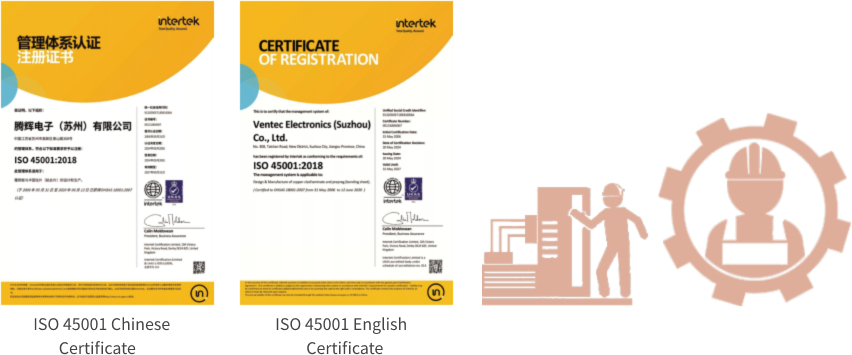
Ventec upholds a "people-first, safety-foremost" philosophy and is committed to providing a safe and healthy workplace for all employees. To prevent occupational incidents, relevant units conduct monthly inspections of the environment and facilities in accordance with local laws and the Company's policies for each plant. The Company has implemented the ISO 45001 Occupational Health and Safety Management System and obtained third-party certification (latest certificate valid from May 2024 to May 2027). This establishes a comprehensive OHS management system with continual-improvement mechanisms to ensure regulatory compliance and reduce occupational risks.
Ventec is committed to providing a safe and healthy working environment for all employees. Each
year we deliver OHS education and disaster-prevention training (e.g., emergency evacuation drills)
and, every six months, plant-wide fire-protection drills (e.g., hydrant operation, hands-on CPR and
AED). These activities strengthen employees' basic knowledge and skills in disaster prevention
and response. We also arrange regular health examinations for all employees and special medical
checks for those engaged in special operations to safeguard employee health.
To build safety awareness, new hires must complete OHS onboarding that covers: national
occupational-disease prevention policies, the Company's rules on occupational-disease
prevention, positions that may be exposed to occupational health hazards, enhancing
occupational-health protection awareness, case studies of occupational incidents, and overviews
of Company processes and production. Appropriate training is also provided to general employees
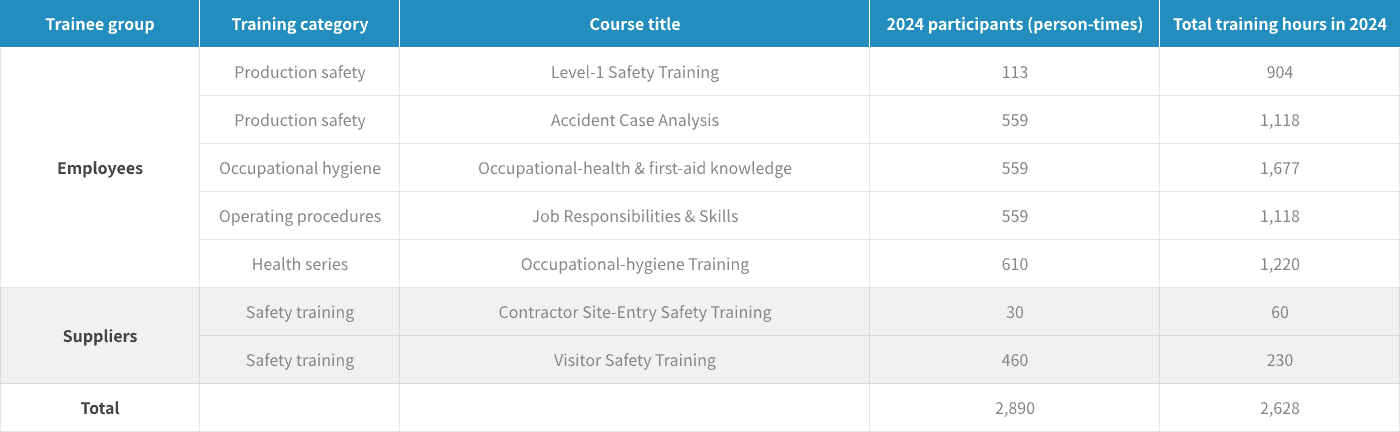
and suppliers as needed. OHS training in 2024 is summarized below.
Ventec has established a comprehensive mechanism for reporting,investigating, and preventing occupational injuries in accordance with
the Occupational Safety and Health Act and the ISO 45001 management
system. When an incident occurs, the on-site supervisor immediately
initiates the reporting process, assists the injured employee in obtaining
medical attention, secures the scene, and files the required report with
the competent authority. An incident investigation team is convened
to investigate each case and conduct root-cause analysis. Corrective
and preventive actions are then formulated based on the findings, such
as revising operating procedures, strengthening training, improving
equipment, or adding workplace safety facilities. We also incorporate
lessons learned into training materials and regularly share case studies
with all employees to reinforce risk identification and self-protection. All
actions are tracked within the OHS management system to verify progress
and effectiveness, ensuring similar incidents do not recur. Through
transparent, timely, and institutionalized response and prevention, we
continue to enhance organizational risk control and fulfill our commitment
to employee safety.
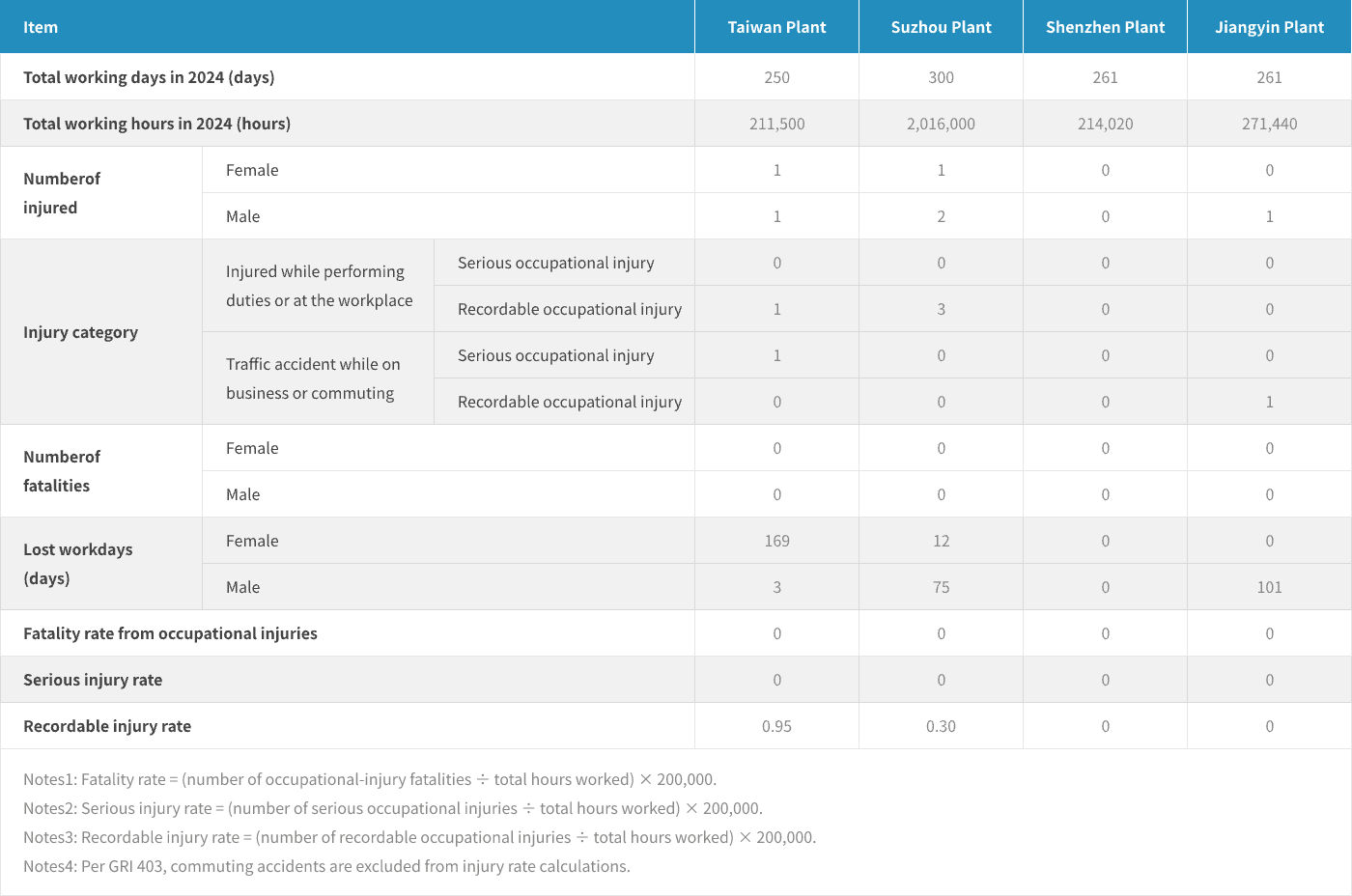
In 2024, the statistics by plant are shown below. There were zero cases of
serious work-related injury while performing duties or at the workplace;
four recordable work-related injuries; and two traffic accidents while on
business or commuting to/from work. No occupational disease cases
occurred among employees or contractors in 2024.
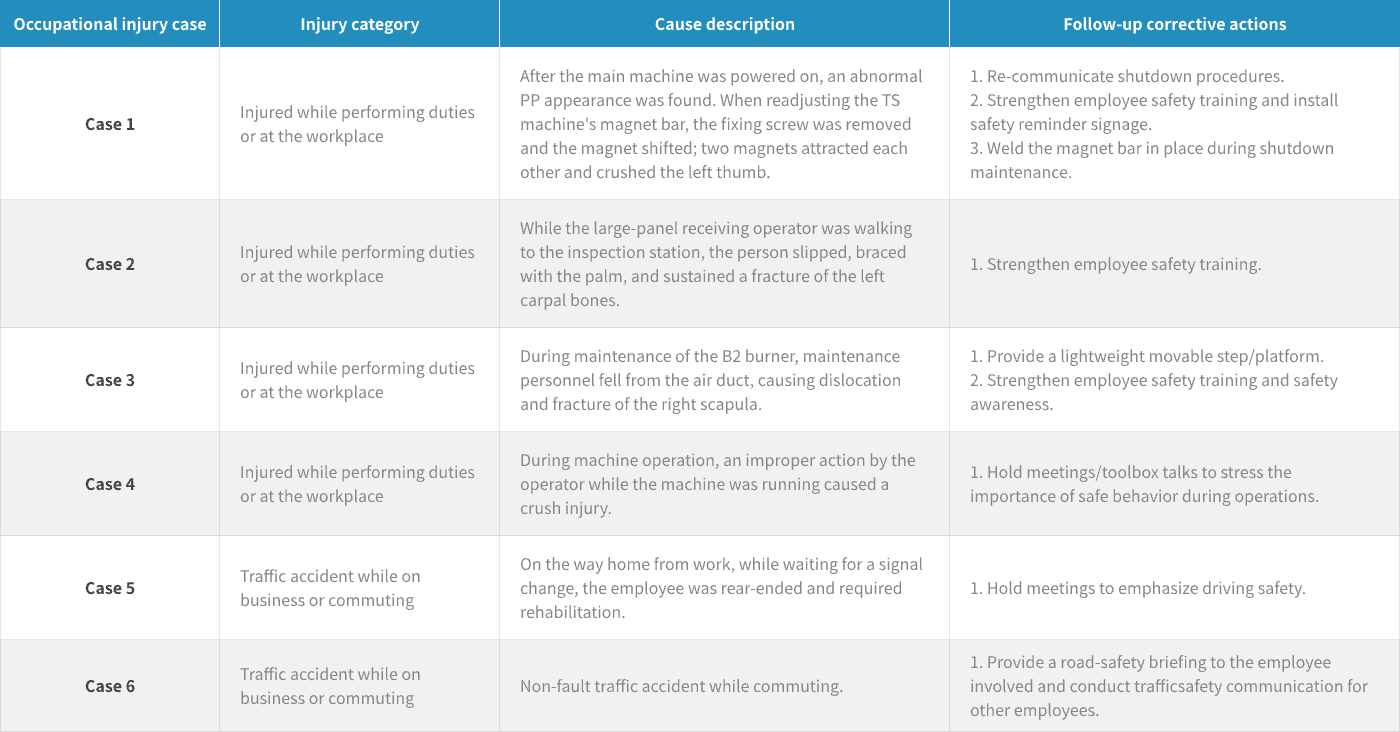
For the six occupational-injury cases that occurred in 2024, the Company conducted in-depth cause analyses and implemented follow-up corrective actions, as summarized in the table below. In addition, the relevant departments perform hazard identification, risk assessment, and tiered risk control every year, and work to eliminate potential hazards and minimize risk by posting safety warning signs, conducting regular safety training, arranging periodic health examinations, and giving pre-job safety briefings, so as to ensure the safety of all employees.